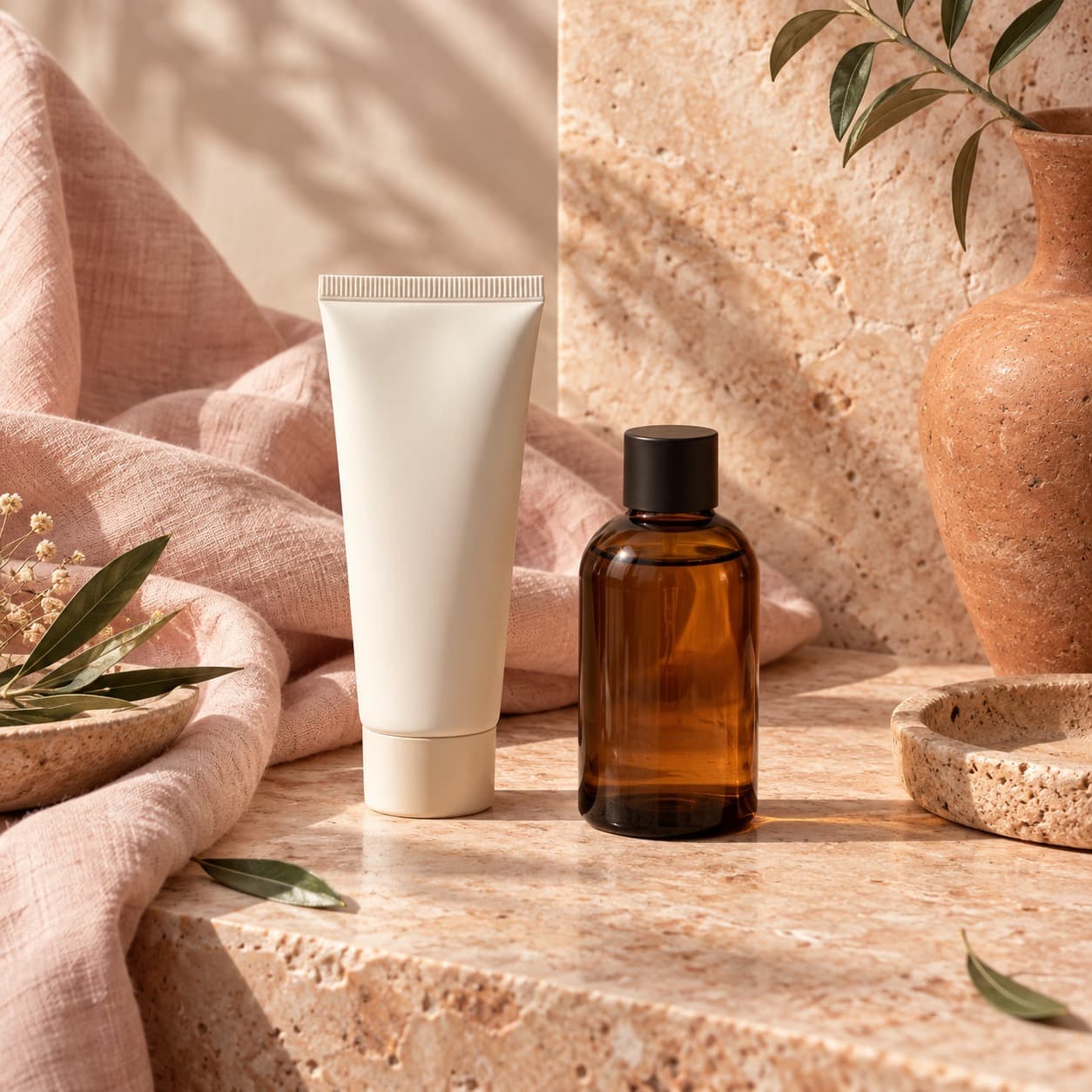
Face and hands
A soft, plain cream for the face and hands, in a tube you can finish. Then another comes.
₩28,000 · 30 mlO · 15 / 26
Warm, tactile, shaped by hand.
Entries closed in January 1941; the winners went on show that September.
In 1940 the Museum of Modern Art in New York opened a competition, “Organic Design in Home Furnishings”. Its organiser, Eliot Noyes, called a design organic when its parts sit in harmony with the whole, in structure, material and purpose. Charles Eames and Eero Saarinen won two first prizes, one with a chair whose seat was a shell of plywood moulded in three dimensions, which no factory could yet make in numbers.
The forms were older than the name. Alvar Aalto had bent plywood into the Paimio chair by 1932, and gave his 1936 Savoy vase an outline often likened to a lake shore. Isamu Noguchi set a free-form slab of glass on two curved wooden legs that lock together, and from 1951 shaped light from paper over bamboo.
On a screen it means curves with uneven radii: a card is a pebble, a picture an arch, and no corner a right angle. Flat fills carry a faint grain, as paper and clay do. Colour comes from the earth, cream, blush, sand and terracotta, with the dark clay kept for words. And motion eases in and out like breath, slow enough to feel, and still when someone asks for less.
ONYU’s app, on a phone. Begin, pause and unwind with a few small steps, say how your skin feels today, and choose a cream and how often it comes. Nothing here is for sale; it only shows how a gentler day might go.
The parts the app is built from: pebble buttons in terracotta, fields like soft wells, stones for switches and checks, a stone thumb on the slider, and no right angle anywhere. Rows of states hold still for comparison; everything else works.
Nothing in your bag yet.
Where the refills go: five numbers.
Dry wood, like a pencil just cut.
Balanced today, so the usual steps are all it needs.
From 1:00 pm, and back at 1:05 pm.
A fresh start.
3 steps to go.
1 of 4 steps done.
One count, as a bar and as a ring. Both end round, and the ring runs clockwise from the topSize
Warm a little cream in your palms and press it in, morning and night. On a dry day, add a second layer where your skin feels tight.
A 30 ml tube, ₩28,000, every 4 to 12 weeks, as often as you choose. At 6 weeks the next would come on Thursday 24 December.
A soft, plain cream for the face and hands, in a tube you can finish. Then another comes.
₩28,000 · 30 mlStep 2 of 4, cream. Choose a size and a scent.
Stepping stones, each a different pebble along a drawn path; the one you’re on breathes while motion is allowedEvery shape here is eight radii. Drag its eight handles, use the keys, or ask for a new pebble; set how soft it is and how much grain it carries, in clay, sand, moss or stone. It breathes while motion is allowed. Copy it as CSS, or take it away as SVG.
Drag a handle along its edge. Or pick one with Tab: the arrows move it, Shift moves it ten, and Home and End go to 0 and 100. A hollow handle is under the softness, so the pebble rounds it up.
Every radius is lifted to at least this. At 50 the pebble is nearly an ellipse.
The tokens are faint 10, clay 20 and coarse 34. Under type, keep it faint.
/* A clay pebble, softness 20 and grain 20. Its radii are
   in percent, so it keeps its shape at any size in a 5 by 4 box. */
.pebble {
  aspect-ratio: 5 / 4;
  border-radius: 63% 37% 54% 46% / 55% 48% 52% 45%;
  background:
    url("data:image/svg+xml,%3Csvg xmlns='http://www.w3.org/2000/svg' width='180' height='180'%3E%3Cfilter id='g' x='0' y='0' width='1' height='1' color-interpolation-filters='sRGB'%3E%3CfeTurbulence type='fractalNoise' baseFrequency='0.85' numOctaves='3' stitchTiles='stitch'/%3E%3CfeColorMatrix values='0 0 0 0 0 0 0 0 0 0 0 0 0 0 0 0 0 0 3 -1.2'/%3E%3CfeComposite in='SourceGraphic' operator='in'/%3E%3C/filter%3E%3Crect width='180' height='180' fill='%234e2f29' opacity='0.2' filter='url(%23g)'/%3E%3C/svg%3E") 0 0 / 180px 180px,
    #b97a62;
}The same eight radii as one path, its corners drawn as elliptical arcs, filled in clay with the grain as an feTurbulence filter in kiln. 480 by 384.
Ten colours with their contrast, a soft serif and a humanist sans, six pebbles of eight radii each, a scale where each step is the two before it added together, three strengths of grain and three speeds. Copy them as custom properties, with the pebble, the grain and the button.
:root {
  /* Cream, clay and blush. The rule draws lines and never carries type. */
  --cream: #fff8f0;
  --oat: #f4e6d9;
  --blush: #eed7c8;
  --sand: #e2c2b1;
  --rule: #d9b8a5;
  --clay: #633d35;
  --ink-2: #7d5649;
  --terracotta: #764c40;
  --clay-deep: #4e2f29;
  --ember: #9b3b2a;

  /* Type */
  --font-serif: 'Young Serif', Georgia, serif;
  --font-sans: 'Figtree', system-ui, sans-serif;

  /* Space: each step the two before it added together */
  --space-1: 5px;
  --space-2: 8px;
  --space-3: 13px;
  --space-4: 21px;
  --space-5: 34px;
  --space-6: 55px;
  --space-7: 89px;

  /* Pebbles: eight radii each, and never a right angle */
  --pebble-river: 63% 37% 54% 46% / 55% 48% 52% 45%;
  --pebble-seed: 50% 50% 46% 54% / 64% 64% 36% 36%;
  --pebble-cobble: 47% 53% 38% 62% / 52% 39% 61% 48%;
  --pebble-arch: 50% 50% 14% 12% / 36% 36% 9% 8%;
  --pebble-slab: 30px 38px 32px 42px / 36px 30px 40px 34px;
  --pebble-bead: 26px 30px 28px 24px / 24px 28px 26px 30px;

  /* Grain, and the three speeds */
  --grain: 0.2;
  --noise: url("data:image/svg+xml,%3Csvg xmlns='http://www.w3.org/2000/svg' width='180' height='180'%3E%3Cfilter id='g'%3E%3CfeTurbulence type='fractalNoise' baseFrequency='0.85' numOctaves='3' stitchTiles='stitch'/%3E%3CfeColorMatrix values='0 0 0 0 0 0 0 0 0 0 0 0 0 0 0 0 0 0 3 -1.2'/%3E%3C/filter%3E%3Crect width='180' height='180' filter='url(%23g)'/%3E%3C/svg%3E");
  --breath: 6s ease-in-out;
  --settle: 900ms cubic-bezier(0.22, 1, 0.36, 1);
  --press-speed: 240ms cubic-bezier(0.33, 1, 0.68, 1);
}

/* A pebble keeps its eight radii: .pebble is the river, or name one */
.pebble {
  border-radius: var(--pebble-river);
}
.pebble-seed {
  border-radius: var(--pebble-seed);
}
.pebble-cobble {
  border-radius: var(--pebble-cobble);
}
.pebble-arch {
  border-radius: var(--pebble-arch);
}
.pebble-slab {
  border-radius: var(--pebble-slab);
}
.pebble-bead {
  border-radius: var(--pebble-bead);
}

/* Grain: noise in the clay, over the fill and under what sits on it */
.grain {
  position: relative;
  isolation: isolate;
}
.grain::before {
  content: '';
  position: absolute;
  inset: 0;
  z-index: -1;
  border-radius: inherit;
  background-color: var(--grain-ink, var(--clay));
  opacity: var(--grain);
  -webkit-mask-image: var(--noise);
  mask-image: var(--noise);
  pointer-events: none;
}

/* The button: terracotta in a bead, pressed in while it is held */
.button {
  display: inline-flex;
  align-items: center;
  justify-content: center;
  gap: 8px;
  min-height: 52px;
  padding: 0 26px;
  border-radius: var(--pebble-bead);
  background-color: var(--terracotta);
  color: var(--cream);
  font: 600 16px / 1 var(--font-sans);
}
.button:hover {
  background-color: var(--clay);
}
.button:active {
  background-color: var(--clay-deep);
  transform: scale(0.97);
}
.button:focus-visible {
  outline: 3px solid var(--clay);
  outline-offset: 5px;
}
@media (prefers-reduced-motion: no-preference) {
  .button {
    transition:
      background-color var(--press-speed),
      transform var(--press-speed);
  }
}Where the style shows up outside this page.